Tuesday, November 1, 2011

Portfolio deconstruction

Here's a quick look at my portfolio as of now:

~30% in cash - looking for short term plays and liquidity when the volatile markets swing in my favor

~ 30% short Europe - through ETF's / put options

~5% short the Euro/USD - Euro has had it's run up, expecting low 1.3x by the end of the year on nothing good coming out of the Eurozone.

~10% physical silver - PM's are a great store of value.

~ 25% pot pourri of hand-picked stocks that are underweight utilities and overweight non-cyclical goods & services. Net short on financials.

Plan on playing more broadly as this market is definitely headline driven. Watch out for news out of Europe, and for God's sake stop buying on the rumor and selling on the news. All positive news out of Europe coming from FT.com or The Guardian is utter nonsense, and nothing is credible unless an official is willing to put his name behind it. The half-life of rumors has died down considerably, but that hasn't helped market volatility.

If you want you can try and be nimble and take a quick profit off rumors & their subsequent refutation, but that depends on your risk appetite. Mines is currently smaller than usual, and I am looking for more convergence trades and obvious mispricings (VIX @ 25?!).

Happy trading.

The Big Three

Forget Greece for a second. Forget Italy. Forget the individual countries, and let's look at Europe more systemically. There are three issues that seem to be good flag posts for the ongoing crisis, and there can't seem to be a solution that solves all three. Addressing two of the three issues seems to starve the third of much needed attention.

Those three things are:
1) Bank solvency
2) Sovereign stress
3) Bank funding

It's interesting how when addressing bank funding and bank solvency (naked CDS/stock shorting ban), the sovereign risk seems to have blown out.

Over the next three years, ~$1.7 trillion worth of debt needs to be rolled out (either paid or kicked down the road with the issuance of new debt). An EFSF levered 4x-5x will not be able to cover such an amount, not to mention the bank recaps and continual buying of securities. A number closer to $2 trillion would be needed... but seeing as how bond auctions can barely get covered in Europe as it is now, all with extremely high yields, it does not seem like this problem is shrinking nor solved.

Wednesday, October 26, 2011

A Deal!

Yay! The Eurozone is saved!

Private investors have agreed to a 50% haircut on their Greek debt... but is it really a 50% haircut? As ZH reports:

  • Greece has €350 billion in total debt including about €70 billion in Troika "post-petition" loans; these are untouched.
  • Of the €280 billion, roughly €75 billion is held by the ECB: this, like the Troika loans, will be untouched.
  • This leaves just ~€200 billion in actual debt to undergo a haircut.
  • Apply a 50% haircut to this debt (ignoring the fact that of this about €35 billion is held by Greek pension funds, and once the realization that Greek pensions have been cut in half dawns upon the population, the result will be the biggest riots ever seen in Athens yet).
  • Total debt to be cut: just about €100 billion.
  • Hence, of the total €350 billion, just €100 billion is eliminated, most of it used to backstop and service Greek pension and retirement obligations
  • €250, or the residual, of €350, the original, means 72%, or a 28% haircut.
  • Greek GDP was €230 billion on December 31, 2010 and declining fast.
  • And that is how a 50% haircut is "cut" almost in half

The real question is... how is this going to affect the banks that are holding on to massive amounts of Greek debt? Many of them are currently under review for credit downgrades... this will only be fuel to the contagion fire.

Sunday, October 2, 2011

Opportunity Knocks

Another great chart by ZH.

What can you do with this chart? The possibilities are endless. Let me give you some background first.

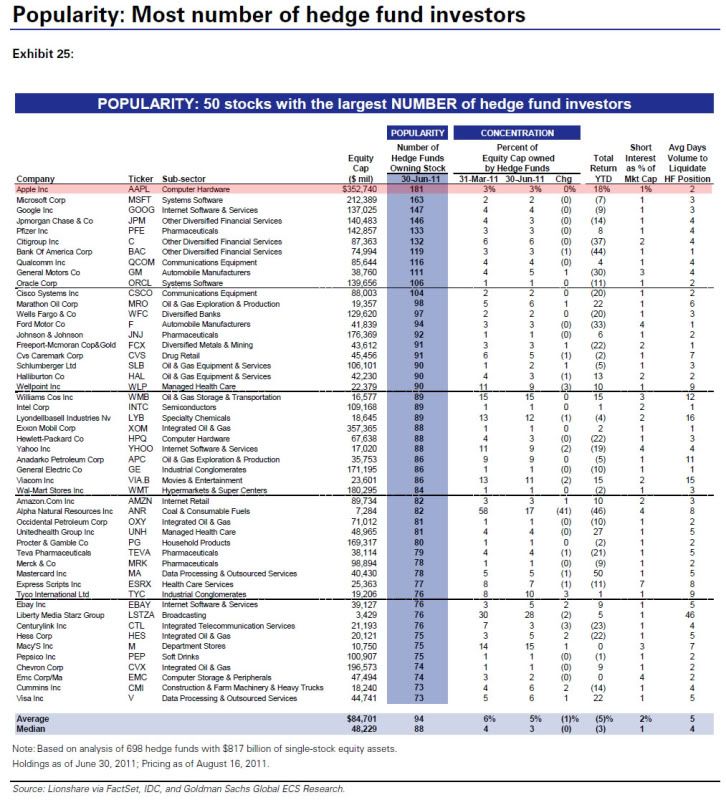
This past Friday(9/30/2011) was the last day of the quarter, as well as the last day for redemptions to be filed with hedge funds. Because of the volatility of the marketplace recently, fear is drowning out greed as people are moving their risky assets to safer ones as well as hoarding cash. This means that a good amount of people want out of hedge funds, and would prefer safer investments like Treasuries (beware of Treasuries - read a couple posts below). With redemptions comes the need to raise cash to pay back to investors. Thus comes the power of this chart.

Photobucket

Using your own methods, you can decide what stocks will probably take a hit while hedge funds are trying to raise cash and dump stock. Realize that multiple funds will be wanting to get rid of overlapping positions, and there is a first mover advantage to this (higher exit price).

Some things worth considering are:
  • Size of positions in stocks
  • Liquidity of stocks (use the higher liquidity ones as a signal of selling - then short lower
    liquidity stocks)
  • Past returns (hedge funds would prefer to book profits rather than cut losses - sell stock that have had positive returns as opposed to writing off losses)
I'll let you come up with your own strategy, as I have my own. I'm providing you the tools and train of thought to profit from this, please take advantage and also bounce ideas around with me.

Risks:
  • Hedge funds might sel off some of one stock, but not the one you short
  • Game Theory - Anticipate moves and counter them before-hand
  • Liquidity - Hedge funds might not liquidate stocks that take a while to get rid of
  • Dark Pools - stocks get traded off the exchange among diff funds, usually in big blocks

My guess is that there will be a lot of mixing in the dark pool, most likely at discounts that will be somewhat reflected in the price. Use quickly liquidated positions as signals for slower liquidation stocks. Stay alert, do your homework, check out implied volatilities - take advantage of cheap options.


There's a rough road ahead, let's take advantage of it!

Friday, September 30, 2011

CORN-Y

There was an article in ZH today talking about how corn futures stopped trading for the day due to massive price movement:

"Back in April, when we first discussed the hike in daily corn trading limits from $0.30 to $0.40, we had some cynical observations, namely that "inviting not only more vol (read bottom line for the business) but more margin, the CME is exposing speculators to far greater impacts from margin hikes (and drops). Which of course means a far great capacity and ability to kill any commodity rally dead in its tracks." Well, there is no margin hike today (yet), although based on today's action we fully expect one. The reason, we are currently at today's down 40 cent limit, a price of $5.925 a bushel, the lowest since July 1, and by the looks of things it will get far worse: as the chart below demonstrates right now sellers outnumber buyers by a ratio of 2000 to 1. Expect this ratio to get even bigger once the CME hikes corn (and who knows what other commodity) margins as soon as today."

With this information, I did some really really quick research and came up with a trade.
My trade thesis is:

1) With the 40 cent limit being hit (so much more selling interest compared to buying), a potential margin hike due to crazy volatility, and the retreat from commodities into cash... my guess is that corn futures prices will probably gap down again at the open.


Here is the graph of CORN, an ETF that follows the price of corn futures. If you look the last bar chart is the price movement today, and the 2nd to last is the price movement yesterday. Look at that huge gap down. I definitely think that if nothing else comes out of this, there will be a margin hike that will force selling of corn futures, lowering the price of them... lowering the price of CORN, putting any shorts in the money.

Vermont-based Teucrium Trading LLC

Teucrium Corn Fund ETV (CORN)

Like most commodity ETFs, CORN will achieve exposure to the underlying commodity through futures, in this case contracts traded on the Chicago Board of Trade. But unlike a lot of products out there, CORN won’t invest exclusively in near month contracts; assets will be split between second-to-expire futures (35%), third-to-expire futures (30%), and futures expiring in the December following the expiration month of the third-to-expire contract (35%).


There are many risks to consider in this trade, here are a few of them:
  • CORN price tracking with corn futures price. (Considering this ETF is based on multiple corn futures contracts, this risk seems very small)
  • Rise in the price of corn futures. Very possible with such a large gap down. This of course is the biggest risk.
  • Settlement dates interfering with prices. The settlement date just passed (in Sept), and if you look at the ETF's composition, it appears that the any movement in settlement is largely offset by the proportion of long-term contracts.
  • Counterparty risk. Who is Teucrium Trading? They have multiple commodities ETF's and look to be a pretty solid company. Besides, if you're shorting...


Good luck and happy trading.

Disclosure: I am currently short CORN.

Thursday, September 29, 2011

Why You Should Short Bonds

There are three reasons why bonds would have a great return if you short them. They are as follows:

  • The credit risk of most bonds (including sovereign bonds) is high - especially compared to their respective ratings.
  • Interest rates are currently artificially low, and when they eventually rise - prices will fall (bond yield and price have inverse relationships).
  • Bonds are denominated in currencies. Currencies, such as the USD, will lose a lot of value in the coming times (due to Keynesian monetary policy).

All these ideas are from Doug Casey, and he has a proven track record of being right on the condition of the economy and where it's headed.

Wednesday, September 28, 2011

Words of another

Here are some choice words from Rich Fisher, president of the Dallas Federal Reserve Bank, talking about the aftermath of Operation Twist:

Jan Mayen is a desolate volcanic island located about 600 miles west of Norway’s North Cape. It is the home of a meteorological and communications station manned in the harshest of winters by 17 hearty members of the Norwegian Armed Forces. If you read Tom Clancy’s Hunt for Red October, you would know it as “Loran-C,” a NATO tracking and transmissions station. In the video game Tomb Raider: Underworld, Lara Croft visits Jan Mayen in search of Thor’s Hammer, considered the most awesome of weapons in Norse mythology, capable of leveling mountains and performing the most heroic feats.

My brother Mike recently visited this station on Jan Mayen. This is the sign that greeted him.

In Norsk, it reads as follows:
“Theory is when you understand everything, but nothing works.”
“Practice is when everything works, but nobody understands why.”
“At this station, theory and practice are united, so nothing works and nobody understands why.”